
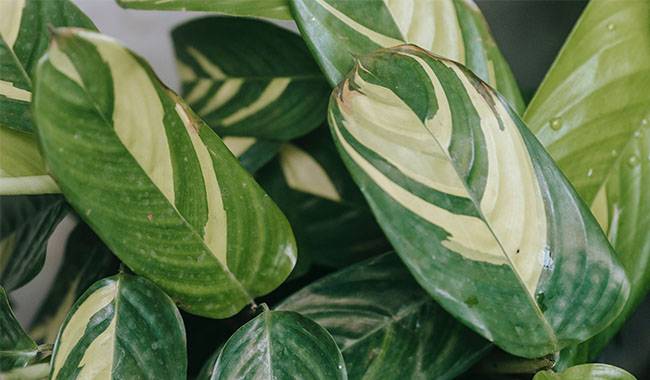
Ctenanthe is often confused with its relatives Maranta and Ctenanthe. It is not only because of its external similarities but it is often considered identical in care. Despite its kinship, Ctenanthe remains distinct from other flowering species. This plant is a true fixture in modern interiors – for experienced growers or those prepared to give it the careful care it deserves. The perfect ovals on the slender petioles and the harsh contrasting patterns give Ctenanthe’s plants a primitive, somewhat “cold” look. But when used properly, this disadvantage can become an advantage. You will learn how to grow Ctenanthe plants in ThumbGarden’s article.
CTENANTHE PLANT DESCRIPTION
The genus Ctenanthe is represented by modern indoor plants in every sense of the word. It is not only the special colors, plain beauty, and smart foliage, decorated by a contrasting game of dark green with silver or cream, but also the possibilities of using these plants.
Ctenanthe plants belonging to the Ctenantheaceae family are evergreen, stemless perennials easily distinguished from their relatives by their limited pattern, more elongated rectangular, oval leaves, and petioles at least twice as long as those of caladiums.
Despite the wide variety of shapes, Ctenanthe’s leaves are always recognizable. The elongated ovals have an ovate or almost rectangular base by their flat, smooth edges and nearly perfect symmetry. The leaves are large, 8-16 inches (20-40 cm) long, on very tall thin petioles.
The leaves unfurl from their characteristic “tubes,” rising strictly upward at night and in the heavy shade with a crackling sound, and falling again during the day, giving a spectacular pattern. Ctenanthe, responsive to light, self-adjusts its tilt to protect itself from sunlight, indicating too high temperatures or lack of moisture – from sticking out of the ribs to pressing down on the petiole.
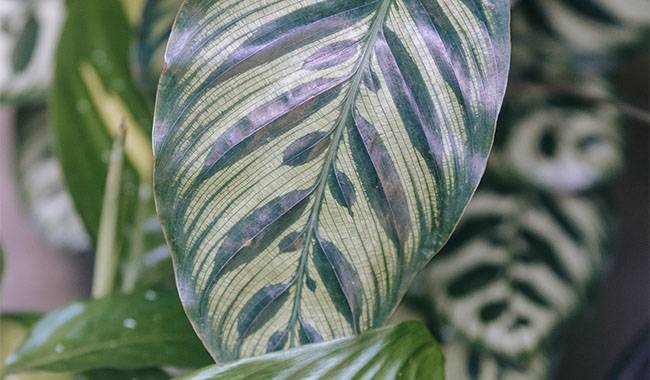
The rich green color is a virtue that makes Ctenanthe almost ideal for modern design styles. Ornamental and always contrasting, Ctenanthe’s leaves contrast dark green margins and veins with a “solid” silver spot between them. The purple reverse is only visible when it rises, but it is no less ornamental to the plant.
TYPES OF INDOOR CTENANTHE
Ctenanthe oppenheimiana is one of the largest and most famous species of Ctenanthes. It reaches a height of 40 inches (1 meter), grows huge oval leaves up to 20 inches (50 cm) long, and looks completely flat. A specimen species with silvery dark green contrasting veins and leaf plates and a dark purple underside.
Ctenanthe setosa is a large species with narrower stripes, a broadened leaf base, and thick pubescent petioles.
Ctenanthe compressa is a medium-sized species, up to 20 inches (50 cm) long, with white-gray leaves without contrasting black stripes and an almost rectangular outline.
Ctenanthe Burle-marxii is a beautiful low species up to 20 inches (50 cm) tall with broad silvery leaves having a blunt tip and very fine stripes.
Ctenanthe amabilis is a compact gray-green species that almost form bushes and grows rapidly to 20 inches (50 cm) tall.
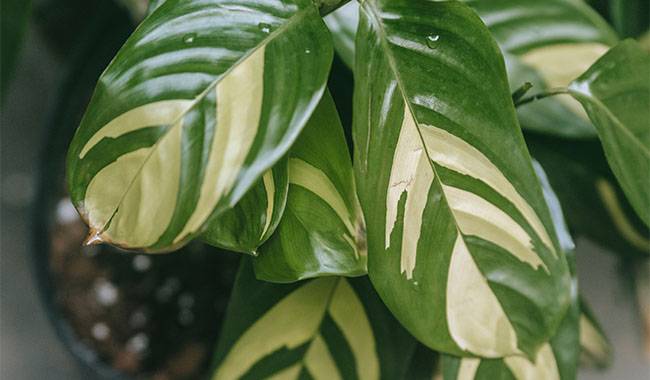
Ctenanthe lubbersiana is slightly stunted, up to 31 inches (80 cm) tall, with a yellowish-green underside and a creamy yellow-green upper part, mainly with mottled stripes and broad white or cream stripes.
Ctenanthe marantifolia is a more compact golden species, with compact leaves up to 4 inches (20 cm) with lettuce and yellow stripes and spots.
GROWING CONDITIONS FOR INDOOR CTENANTHE
Ctenanthe is good in its own right. It should not even be mixed with related plants or displayed in complex groups. It shows its beauty only in solitary groups. Therefore, providing it with the “right” ventilation is easier.
Lighting and Placement
It will be comfortable for Ctenanthe to avoid direct sunlight or any color light. The more vibrant the patterns and colors of the species, the more it is like. Any extremes will result in a loss of color, but the shattering of the leaves more easily identifies lack of lightrthwest, north, or east-facing windows, and similar locations are ideal for tenants. In winter, tenants should be moved closer to the windows (or similar measures should be taken to provide additional light).
These animals can be safely kept indoors – as long as they are in a lighted, semi-shaded area. They are also fine on a windowsill but don’t pass up the opportunity to decorate a room near a window with large, green, fresh, and cheeky decorations. Their excellent tolerance of artificial light only enhances the possibilities of use.
Temperature and ventilation
Ctenanthe is an extremely heat-loving plant. Even in winter, temperatures should not fall below 64 °F (18 °C) and in summer below 68 °F (20 °C.) Ctenanthe is also not keen on overheating, especially if the humidity of the air is severely affected, but they will usually grow very well in a warm room.
Ctenanthe does not like changes and sudden changes, nor does it like any wind movement. You should carefully choose a place for it where it can stand for many years.
The air around the shrub should circulate freely. The plant can be brought into the fresh air in summer, but only in a sheltered, semi-shady place and when the nighttime temperature does not fall below 55 °F (13 °C).
CARING FOR CTENANTHE PLANTS AT HOME
It needs to maintain a high level of air humidity, which is the most difficult ctenanthe to cultivate. But it also does not like to be lax in watering.
Watering and air humidity
Only soft, preferably purified, molten water at room temperature or rainwater is suitable for Ctenanthe. Watering frequency is standard, with the top layer of the substrate drying out after 5 minutes and water draining from the tray. The lower the temperature, the drier the substrate will be.
If the humidity is below 55%, the plants suffer greatly and cannot tolerate the proximity of air conditioners and heaters. The best option is to use a humidifier or a tray with wet moss or pebbles (no water contact with the bottom of the pot). But except for humidifiers, use a sprayer and soft, warm water to water the plants.
Feeding and fertilizer composition
Ctenanthe’s animals only need fertilizer when they are growing vigorously. After transplanting, fertilization can be resumed after 4-5 weeks and repeated every 2 weeks starting in March in years without transplanting. Finish fertilizing in September, gradually reducing the dosage. Ctenanthe does not like long-lasting fertilizers and prefers liquid fertilizers. You can preferably use Maranta fertilizer, but you can also use a mixture of macro and micro fertilizers for herbaceous and ornamental leaves. Again, the dosage should be halved.
Transplanting, containers, and substrates
Tenants should not be unnecessarily disturbed. These plants like to be transplanted “on-demand” because the previous container was filled with roots. And they do not like pots that are too large or too deep. Choose a special, slightly acidic, loose, fertile humus substrate with a coarse fiber texture for growing Ctenanthe grass. It should contain a coarse loosening agent that you can add yourself. It is best to choose a special substrate for Ctenanthe flowers if possible.
The plants are gently transplanted, with only part of the roots exposed when separated. After transplanting, it is best to place the plants in a warm, bright place with plenty of humidity and to water them very carefully.
Diseases, pests and cultivation problems
Ctenanthe’s major health problems begin with dry air. The leaves shrivel rapidly, are almost always pressed down, and growth is stunted. But improper watering is just as harmful and can lead to the rapid spread of rot. Ctenanthe are susceptible to thrips, powdery mildew, and spider mites. They can only be controlled with insecticides.
Ctenanthe propagation
The main method of propagation is to divide into 2-3 parts at transplanting simply. The split is carefully cut by separating a group of rosettes or a rosette of individual leaves with a sharp knife. Small sections with only a few leaves are easy to root, but they take a long time to accumulate leaf mass and are best divided into 2-4 parts.